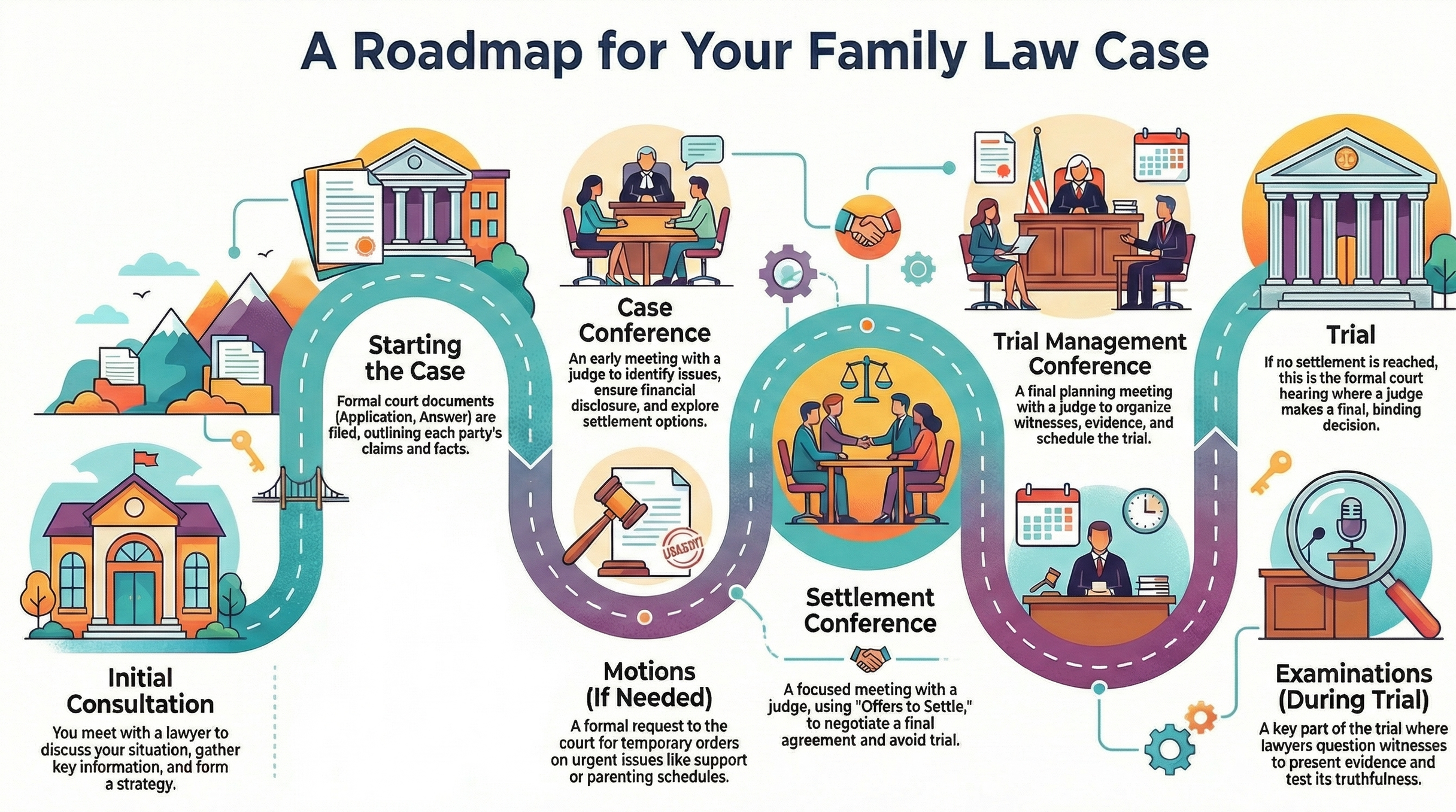
Navigating family law matters can be a challenging and emotional journey. We understand the complexities involved and are dedicated to guiding you through each step of the process with clarity, empathy, and expertise. From the initial consultation to the final resolution, whether through a comprehensive separation agreement or a court order, our team is here to ensure you understand your options and feel supported.
-
![Tax forms and a pen on a wooden surface with a gray zippered case nearby.]()
Disclosure
Financial disclosure is the process by which each party in a family law matter provides comprehensive and transparent information about their financial situation to the other party. This includes details about all income, assets, debts, and liabilities. The goal is to create a complete and accurate picture of each person's financial standing, which is essential for fair negotiations and, if necessary, for the court to make informed decisions regarding support (child and spousal) and property division. This process is mandated by the Family Law Act of Ontario and the Family Law Rules, emphasizing the importance of full and frank disclosure.
-
![Looking up at a historic building with large columns and detailed statues on the upper facade, with a cloudy sky in the background.]()
Pleadings
Once negotiations have either failed or are deemed inappropriate for a particular family law matter, the formal court process begins with the "pleadings started" phase. Pleadings are the initial set of formal documents exchanged between parties in a lawsuit. In family law, these documents clearly set out each party's claims, the facts supporting those claims, and the specific relief (orders) they are asking the court to grant. This stage marks the transition from informal discussions to a structured legal battle within the court system.
-
![A woman with short blonde hair, glasses, and wearing a blue top with embroidered sleeves, is sitting at a desk in an office, writing on a piece of paper with a pen. She has a computer monitor and laptop on her desk, and the office has a modern, well-lit appearance with large windows in the background.]()
First Apperance
The "First Appearance" is the initial court date in a family law proceeding after an Application has been filed and served. It is typically a brief, administrative hearing designed to get the case organized and set a path for future steps. It's not a hearing where evidence is presented or final decisions are made on the substantive issues of your case.
-
![Hanging sign with the letter 'i' on it, suspended from a wooden ceiling in a modern interior space.]()
Mandatory Information Program (MIP)
The Mandatory Information Program (MIP) is a court-required session designed to provide individuals involved in family law disputes with essential information about the court process and various options for resolving their issues. It aims to educate parties on the legal and personal implications of separation and divorce, encouraging them to consider alternatives to traditional litigation.
-
![Person writing in a planner, with a straw hat and binder clips on a white table.]()
Triage Court
Triage Court is a specialized court process within the family law system in Ontario designed to quickly assess and categorize family law cases. Its primary function is to efficiently direct cases to the most appropriate resolution pathway, whether that involves further conferences, alternative dispute resolution, or setting a course for litigation. It acts as an early filtering mechanism to streamline the court process and ensure that resources are allocated effectively.
-
![A calendar page for the month, with dates marked by red push pins on the 5th, 11th, 17th, 24th, and 30th.]()
Urgent Case Conference
An Urgent Case Conference is a specialized and expedited court appearance in family law designed to address pressing issues that require immediate judicial attention but may not warrant a full "Urgent Motion." It serves as a quicker way to bring critical matters before a judge to seek interim directions or temporary orders, particularly when there are concerns that cannot wait for the standard court process.
-
![People in a business meeting discussing documents, with a gavel on the table.]()
DRO Case Conference
A Dispute Resolution Officer (DRO) Case Conference is a structured meeting with an experienced family law lawyer, known as a Dispute Resolution Officer, who is appointed by the court. The primary purpose of a DRO conference is to facilitate the early resolution of family law disputes, particularly those related to child support and spousal support, without the need for immediate judicial intervention. It serves as an alternative to a traditional Case Conference with a judge, focusing on settlement and clarifying financial disclosure.
-
![Business professionals in suits during a formal agreement negotiation at a wooden table, with documents, a gavel, and a laptop visible.]()
Case Conference
A Standard Case Conference is a mandatory meeting with a judge in a family law proceeding. It is a crucial step designed to move your case forward by identifying and narrowing the issues in dispute, exploring potential settlement options, and setting a clear path for the next stages of the court process. Unlike a trial, a case conference is not where final decisions are made on the substantive matters of your case, but rather a structured discussion aimed at managing the litigation.
-
![A neon sign with the words 'ASK' and 'ASK' in red letters on a metallic background, mounted on a wall.]()
Questioning (Discovery)
"Questioning," often referred to as "Discovery" or "Examinations for Discovery," is a formal pre-trial process in family law where parties and sometimes other relevant individuals (with court permission) are questioned under oath by the opposing lawyer. The primary purpose is to gather information, clarify facts, obtain sworn testimony, and identify all relevant documents and evidence that will be used in the case. It's a crucial step to prevent surprises at trial and to encourage settlement by providing both sides with a complete understanding of the other's case.
-
![A judge's gavel resting on a sound block in front of a woman in business attire, with a scale of justice in the background.]()
Urgent Motions
An urgent motion is a critical tool for seeking immediate judicial intervention in family law matters where time is of the essence. It is important because it allows the court to address crises that cannot wait for the standard legal process, thereby preventing further harm or protecting vulnerable parties.
-
![Person with hands clasped on a desk, in a lawyer's or judge's office, with legal books, a gavel, and scales of justice visible.]()
Procedural Motion (14B Motion)
A Form 14B motion is used for procedural or straightforward requests that can typically be decided by a judge based on written materials without the need for a lengthy hearing. It is a more streamlined process compared to a general motion (Form 14).
-
![A judge's gavel being struck on a sound block in a legal setting.]()
Regular Motion
A Regular Motion (often initiated with a Form 14: Notice of Motion) is a formal application to the court requesting specific orders or relief in a family law case. Unlike urgent or procedural motions, regular motions are used for more substantive issues that require a more thorough presentation of evidence and legal arguments.
A Regular Motion is a crucial step in family law litigation for addressing a wide range of issues that cannot be resolved through agreement between the parties.
-
![A wooden gavel resting on a round sound block on a wooden table in a courtroom or legal setting.]()
Long Motion
A Long Motion is a type of motion in family law that is scheduled for a longer period of time, typically more than one hour, to allow for the presentation of more complex evidence, including oral testimony, and more extensive legal arguments. These motions are reserved for issues that cannot be adequately addressed in a shorter "Regular Motion" due to their complexity or the need for a deeper factual inquiry.
-
![A printed sheet of paper with the word 'SOLVE' in stylized, bold font placed on a wooden desk. A black smartphone is resting on the paper. Part of a computer keyboard and monitor are visible, indicating a workspace.]()
Settlement Conference
A Settlement Conference is a formal meeting with a judge in a family law proceeding, specifically designed to facilitate a full or partial settlement of the issues in your case. It is a crucial step where parties, with the assistance of their lawyers and the judge, engage in intensive discussions aimed at resolving disputes without the need for a trial. The focus is on reaching a mutually acceptable agreement that addresses all outstanding matters arising from the breakdown of the relationship.
-
![A judge's gavel, a person in a suit with a tie holding a pen and a notebook, and another person with clasped hands on a table during a legal or judicial discussion.]()
Trial Management Conference
A Trial Management Conference (TMC) is a mandatory court appearance with a judge, serving as the final preparatory stage before a family law case proceeds to trial. Its primary purpose is to ensure that the case is fully ready for trial, to manage the trial process efficiently, and to make one last effort to resolve outstanding issues without the need for a full hearing. It is a critical step to streamline the trial, clarify remaining disputes, and set the logistical framework for the presentation of evidence.
-
![Trial]()
Trial
A trial is the final stage of the litigation process in family law, where a judge hears all the evidence and legal arguments from both parties to make final decisions on the outstanding issues in a case. This is where all interim orders, such as those made during motions, are either confirmed, varied, or replaced by permanent orders.
-
![Close-up of a person's hand holding a 3x3 Rubik's Cube with the words 'FIGURE,' 'IT,' and 'OUT' printed on its red squares.]()
Offer to Settle
An "Offer to Settle" is a formal written proposal made by one party to another in a legal proceeding, suggesting terms to resolve all or some of the outstanding issues in the case. It is a crucial tool in family law designed to encourage settlement and avoid the need for a lengthy and costly trial.
-
![Person analyzing business charts on a tablet with printed graphs and a calculator on the desk.]()
Costs
"Cost consequences" refer to the financial repercussions, typically involving legal fees and disbursements, that a party may face at the end of a motion or trial in family law. These consequences are largely influenced by the parties' conduct throughout the litigation, especially their reasonableness and their use of "Offers to Settle." The underlying principle is that the successful party is generally entitled to some reimbursement of their legal expenses, and unreasonable behavior can be penalized with adverse cost awards.